Development and qualification of sustainable optical materials, SusOptMat
The field of light generation and lighting technology is currently undergoing major changes. Semiconductor light sources such as LEDs, OLEDs and diode lasers are increasingly penetrating the market. Semiconductor light sources such as LEDs now dominate the market, while powerful diode lasers are also finding applications in areas such as projectors. These changes enable and require the use of materials that need to be newly developed or optimized for specific applications. Plastics are particularly important in this context, as the operating temperatures of semiconductor-based lighting systems are generally lower than those of conventional light sources.
The use of bio-based materials from renewable raw materials is particularly attractive in this context. A completely new field of research is the application of bioplastics for optical components, but at the same time the requirements for the materials are particularly diverse and high. Due to the spectral composition of the emission from semiconductor light sources, the radiation exposure is completely different from that of conventional light sources. The high proportion of blue radiation in particular poses a challenge to the stability of many materials. In this context, targeted service life tests are being developed and the various materials and functional materials are being evaluated in terms of their long-term stability and the underlying degradation mechanisms.
In addition to innovation through research, another focus is on innovation in teaching. Of particular note here is the participation in the AR/VR.nrw project, the core of which was the development of AR/VR software for creating vivid learning scenarios for use in teaching. With the aim of sustainable implementation of the software, the working group participated by evaluating the developed solution.
Research Projects
For information about the group's research projects, please refer to the German version of this site.
The Research Group
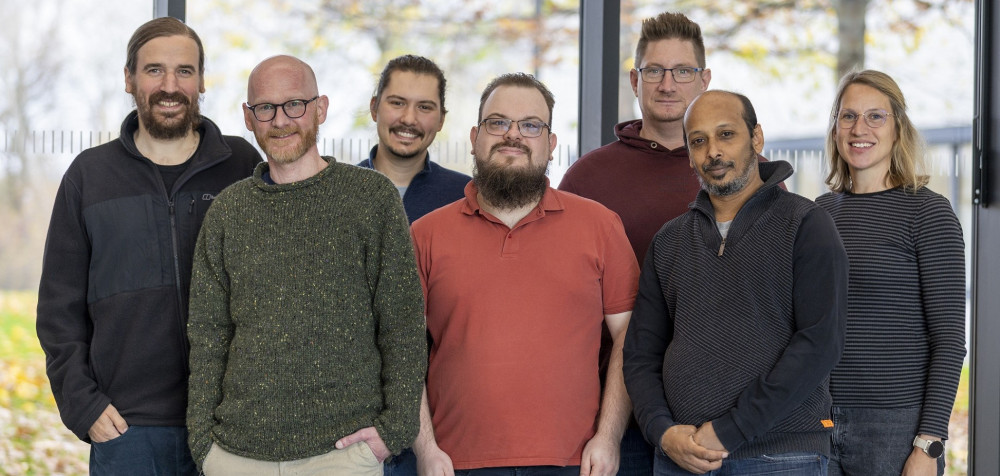 Arbeitsgruppe Nachhaltige Materialien fuer optische Technologien