Apply now
Applications for a place in the summer semester of 2027 will be accepted from October 26, 2026 through January 15, 2027.
Applications are submitted via the student account. Here you’ll find help regarding the student account.
Discover the future of materials science and help build a more sustainable world
The master's program in "Sustainable Materials Engineering" offers a unique combination of materials science and sustainability to train the next generation of scientists and engineers for a green future.
Why study "Sustainable Materials Engineering"?
- Future-focused education: With an emphasis on sustainable technologies and eco-friendly materials, you will be at the forefront of pioneering developments.
- Interdisciplinary content: The integration of materials science, chemistry, biology, and sustainability concepts prepares you comprehensively for current challenges in research and development.
- Specialization options: Choose from four concentrations—polymeric materials, bioinspired materials, optical materials, and materials for electrical engineering—to deepen your expertise in a targeted area.
- Career advancement: This degree qualifies you for demanding roles in research-driven development and opens the door to numerous career paths in industry.
Course of Study
The English-taught Master's programme "Sustainable Materials Engineering" (M.Sc.) is divided into twelve thematically distinct and time-structured modules. The modular curriculum is shown in sample schedules for the full-time and part-time variants. Each module is designed to be completed in one semester. As part of a bridging semester, you have the opportunity to make up any missing subject prerequisites and earn the required credit points.
Advantages of modularization:
- Structured study progression: The self-contained modules enable targeted, semester-precise planning of your course of study.
- Flexibility: Offering both full-time and part-time tracks concurrently supports individual life and work situations.
- Equal opportunity: The bridging semester allows students with different academic backgrounds to make up missing knowledge and start the programme successfully.
Your course of study
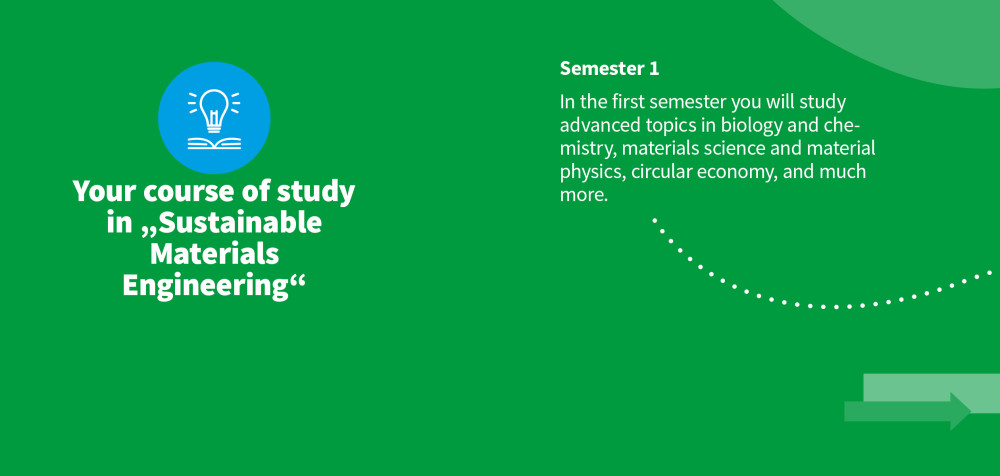
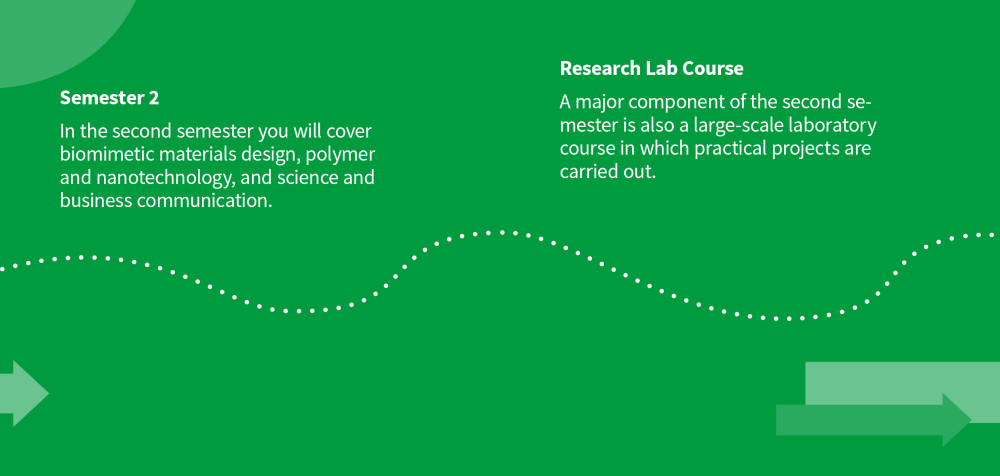
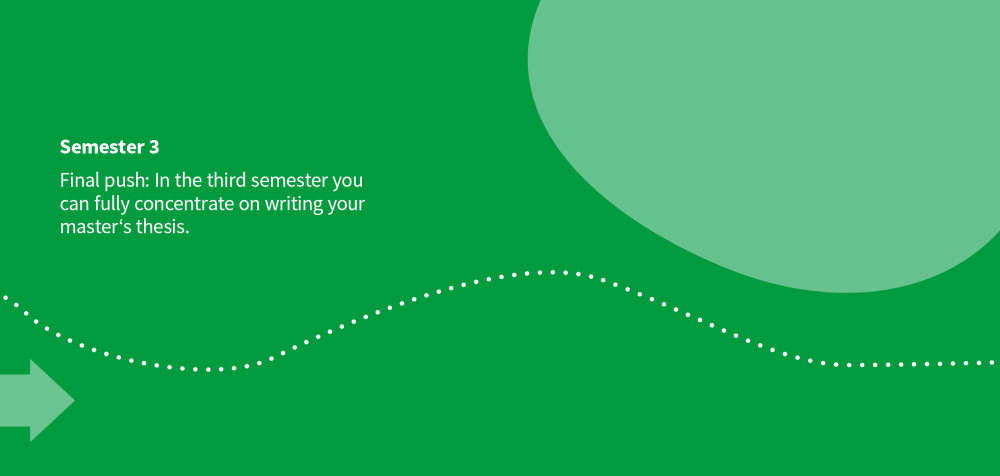
Areas of study "Sustainable Materials Engineering"
In the "Sustainable Materials Engineering" program, you have the option to choose between four specializations:
-
Polymer materials
In the "Polymer Materials" specialization, students gain comprehensive knowledge of the development, processing, and application of sustainable polymeric materials.
- Development of new polymeric materials (synthesis, characterization, processing, testing)
- Improving stability & recyclability
- Formulation development: replacing critical raw materials
- Resources, eco-efficiency & circularity
-
Bio-inspired materials
- Biological and technical materials and their synthesis routes
- Concepts and implementations of modern biomimetics
- Development, production and characterization of synthetic materials based on sustainable, bio-inspired and biomimetic concepts
- Structural and functional applications
-
Optical materials
- Reliability assessment with respect to aging, temperature, and radiation
- Properties: transparency, reflectivity, scattering, absorption, luminescence
- Characterization: spectroscopy, thermal analysis, chemical analysis, mechanical testing
- Sustainability: circularity, reuse, life-cycle analysis, disposal
- Development of new optical materials: structure–property relationships, property optimization
-
Materials in Electrical Engineering
- Physical properties of metals, semiconductors & insulators
- Semiconductor devices
- Materials and processes for assembly and interconnection technologies (soldering, wire bonding, sintering)
- Sustainability of electrical engineering materials: substitution of critical raw materials, recyclability, life-cycle assessment of electronic materials
Admission requirements
Admission to the Master’s program in "Sustainable Materials Engineering" (M.Sc.) requires the successful completion of a Bachelor's degree in an engineering field. The Master's program requires specialized knowledge in at least four of the following six disciplines: biology, chemistry, physics, materials science, bionics, and micro-/nanotechnology.
Language Requirements
Evidence of adequate knowledge of the English language at the level B2 of the Common European Framework of Reference by means of a certificate accordingly is a condition for acceptance. The evidence must be provided by one of the following successfully taken equivalent tests:
- IELTS: minimum 6.0
- TOEFL (internet based test): minimum 80
- TOEFL (paper based test): minimum 550
- TOEFL (computer based test) minimum 213
Submission of one of the abovementioned certificates will be waived if there is a corresponding note on the final school or university entry qualification certificate on the grade of English knowledge acquired according to Common European Framework of Reference.
Your future with a Master’s degree in "Sustainable Materials Engineering"
With a master's degree in "Sustainable Materials Engineering", you'll have many career opportunities open to you, such as laboratory manager for sustainable materials development, research or development engineer for eco-friendly materials, production or process engineer for sustainable manufacturing, and many other fields.
Your Career Opportunities: A Quick Overview
Research & development:
- Polymer or materials scientist
- Lab manager / research engineer for eco-friendly materials
Industry & production:
- Development, process, or quality engineer for sustainable materials, environmentally friendly manufacturing, and/or sustainable products
- Technical product manager for sustainable materials
Sustainability management & environmental engineering:
- Recycling and sustainability manager
- Consultant for sustainable / eco-friendly materials
- Coordinator for environmental and sustainability projects
Academic career & doctoral studies:
- Research associate in sustainable materials research
- PhD candidate in chemistry, polymer science, plastics engineering, biology, materials science, physics, or electrical engineering
Regulation, standardization & consulting:
- Engineer for compliance and standards in sustainable materials
- Specialist for environmental and sustainability certification
- Consultant for regulatory requirements
Are you interested in pursuing a master’s degree in "Sustainable Materials Engineering"? Here you’ll find all the information you need about applying and enrolling. The program will launch for the first time in the summer semester of 2027.
Got questions? Please contact us!
Studying at HSHL
 Person am Meer mit einem imposanten Sonnenuntergang